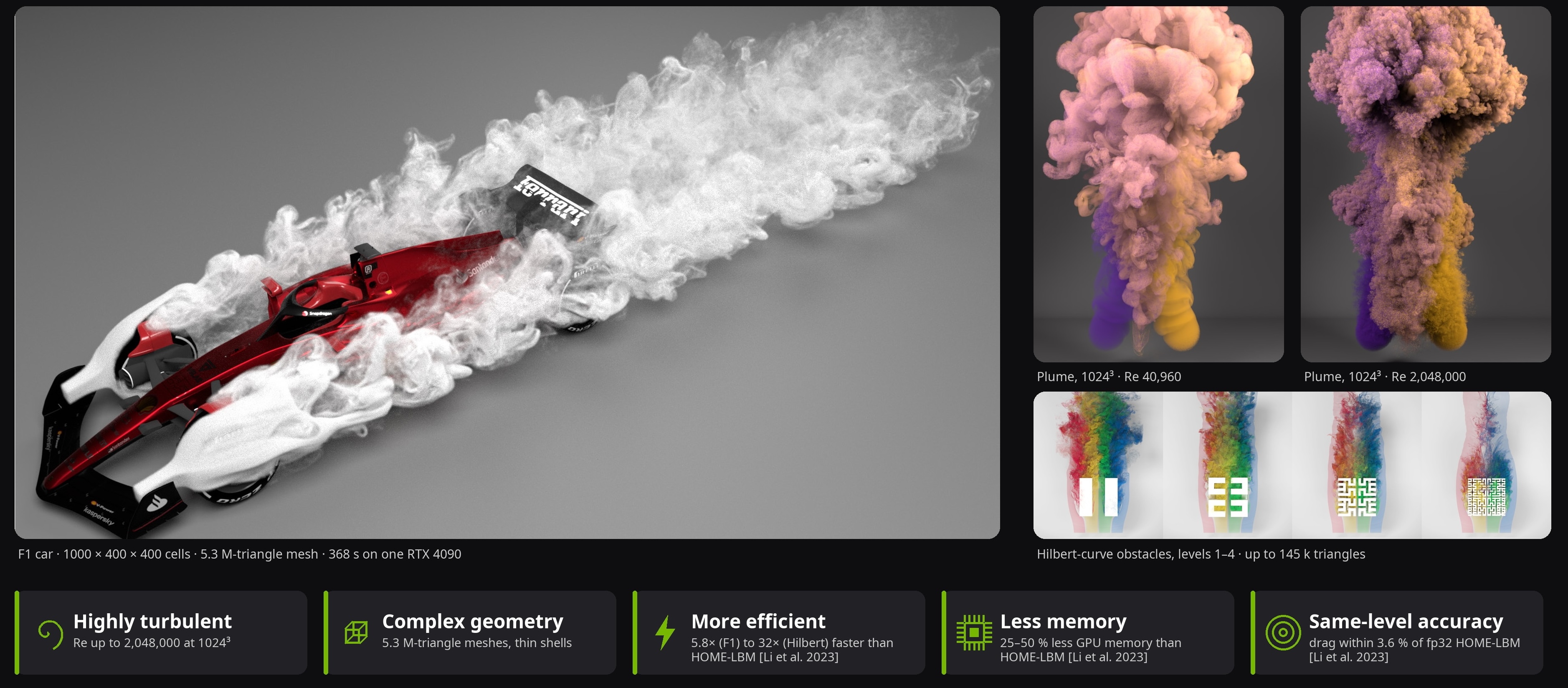
Lattice Boltzmann methods (LBM) are widely used for visually rich fluid simulation, but their high memory bandwidth and storage requirements limit GPU performance and scalability, especially when coupled with complex geometry. Recent high-order moment-encoded LBM (HOME-LBM) reduces memory cost by storing compact velocity moments and performing collision directly in moment space, but its tightly coupled boundary treatment introduces divergent control flow. We present a high-performance, quantized HOME-LBM framework for large-scale turbulent fluid–solid simulations on a single GPU. Our geometry-decoupled computation scheme separates the regular fluid update from a sparse solid-correction stage, isolating geometry-dependent computations to improve GPU efficiency. To further reduce storage and memory traffic, we develop a reduced-precision representation for HOME-LBM by combining von Neumann stability analysis, empirical moment-range estimation, and runtime decomposition of second-order moments to control quantization error. We evaluate our approach on real-time demonstrations and large-scale examples using both D3Q19 and D3Q27 lattices, with additional 2D and 3D numerical experiments assessing accuracy and stability. Across the tested benchmarks, our framework substantially accelerates the original FP32 HOME-LBM implementation, with a maximum speedup of 32.5× on the Hilbert-curve geometry. Moment storage is reduced by 50% in fluid-only simulations and 25% in fluid–solid coupling examples, while maintaining numerical stability, fidelity, and high visual quality. In the static delta-wing benchmark, our solver achieves a 5.2× speedup over Leapfrog Flow Maps (LFM) under the tested configuration.
Coming soon.